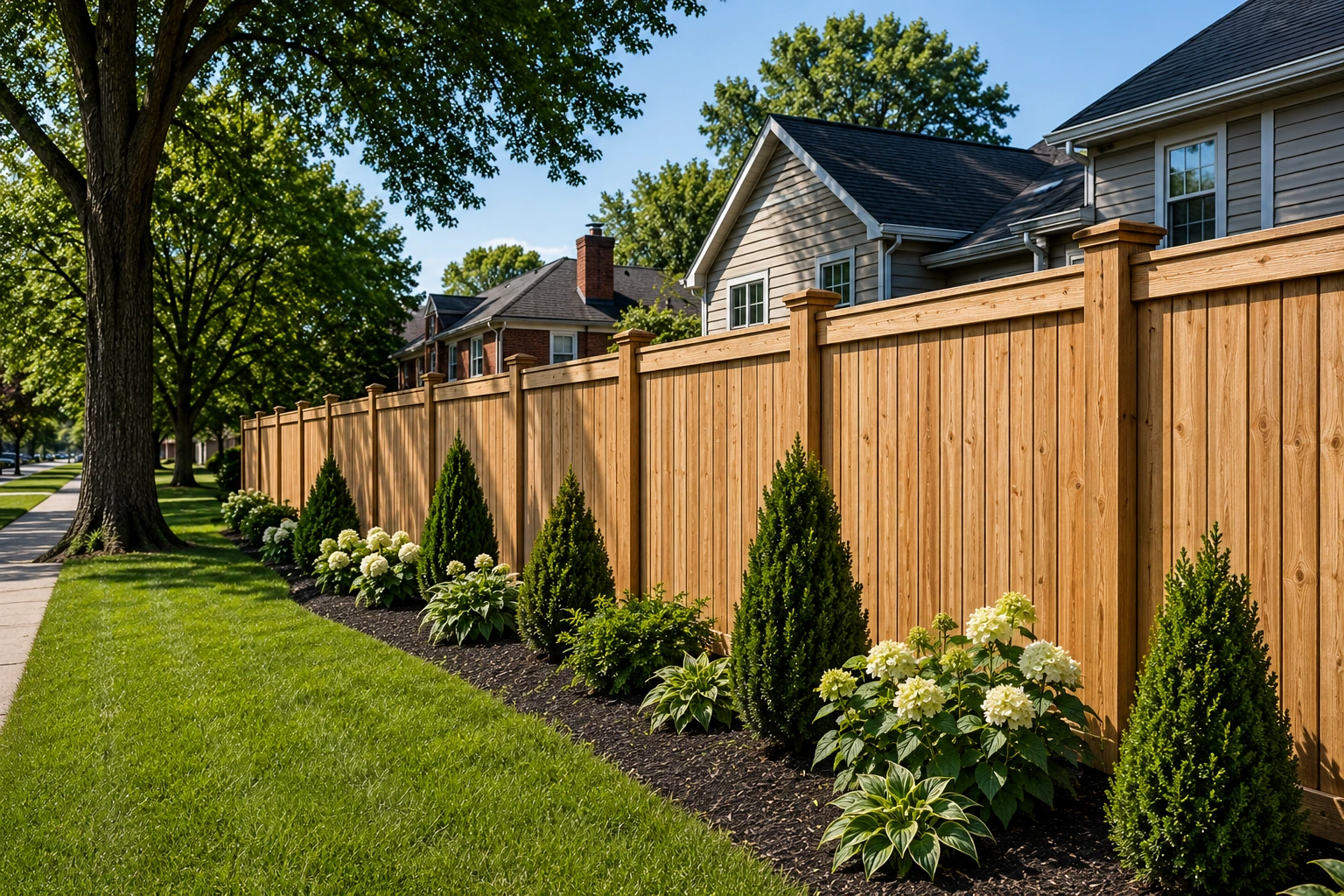
Looking for a fence company in Dayton, Ohio? 937 My Fence — Potter Fence Company — has installed wood, vinyl, aluminum, and chain link fencing across Dayton and Montgomery County since 1997. We’re based in Tipp City, 20 minutes north on I-75, and we work in Dayton neighborhoods every week. From established residential streets in Oakwood and Kettering to older neighborhoods near the Oregon District and South Park, to newer construction on the city’s outer edges, we know what good fence installation looks like in this region — and what shortcuts cost you after a few Ohio winters.
Request a free estimate or call 937-693-3623.
Fence Installation in Dayton — What You Need to Know First
Dayton is a larger, more complex city for fence installation than surrounding suburbs — not because the work is harder, but because there are more variables to navigate before you break ground. The permit process is specific, Dayton has more locally zoned Historic Districts than any other city in the Miami Valley, and the city’s older neighborhoods have tighter lots, mature trees, and property line questions that newer subdivisions don’t. Here’s what matters before you start.
Dayton Fence Permit Requirements
Dayton requires a zoning permit for all fence installations of any height — this is more stringent than many Ohio cities, which only require permits above a certain height threshold. Even a low decorative fence in a front yard needs a zoning permit in Dayton before installation begins.
Here’s how the permit requirement breaks down:
- Zoning permit: Required for all new fence installations regardless of height. Patching or repairing an existing fence does not require a permit. Replacing a fence requires a permit if anything about its location, height, materials, or other characteristics changes. Applications are processed through Dayton’s Zoning Administration at 371 W. Second Street. You can also contact zoning at 937-333-3903 or zoning@daytonohio.gov.
- Building permit: Not required for fences 6 feet or under. Required for fences taller than 6 feet. Call 937-333-3883 for building permit questions.
- Certificate of Appropriateness (COA): Required for any exterior work — including fence installation — on properties within Dayton’s locally zoned Historic Districts. See the Historic District section below.
Dayton Fence Zoning Rules
- Front yard fences: Maximum 42 inches tall. Must have at least 25% transparency — picket fences and wrought iron qualify; solid privacy panels do not. No chain link in front yards in residential zones.
- Side and rear yard fences: Up to 6 feet without a building permit. Over 6 feet requires both a zoning permit and a building permit.
- Corner lots: Sight distance requirements apply near intersections. Contact Dayton’s Zoning Administration before installing on a corner lot to confirm placement restrictions.
For a broader overview of fence permitting across the region, see our Dayton area fence permit guide.
Dayton’s Historic Districts — What Fence Installers Need to Know
Dayton has 23 National Register Historic Districts and more locally zoned historic neighborhoods than any other city in the Miami Valley. If your property is within one of Dayton’s locally designated historic districts, fence installation requires a Certificate of Appropriateness (COA) from the city’s Landmark Commission before work begins — in addition to the standard zoning permit.
Dayton uses three levels of historic district designation:
- HD-2 (most common for residential areas): The most restrictive designation. Requires a COA for any exterior work including fencing. Major modifications require a Major COA reviewed by the Landmarks Commission. Minor projects — including most standard fence installations — can often receive a Minor COA quickly, sometimes same-day from Dayton’s Historic Preservation Officer. Minor COAs are printed on neon green paper and must be posted visibly on the property during construction.
- HD-3: Applied mostly to significant commercial structures. A COA is only required for demolition, not for fence installation.
Dayton’s locally zoned historic districts include South Park, Oregon District, Dayton View, Five Oaks, Grafton Hill, Huffman, McPherson Town, St. Anne’s Hill, and Wright-Dunbar, among others. Each has its own character and some have specific fence guidance beyond the city’s baseline rules.
South Park Historic District — Specific Fence Rules
South Park is Dayton’s largest historic district — a 24-block, 150-acre area of more than 780 structures dating primarily from the 1880s to the early 1900s. It’s governed under HD-2 zoning, which means a COA is required for all exterior work including fence installation.
South Park has some specific fence guidance worth knowing before you order materials:
- Basketweave fences are not allowed in South Park regardless of other permit approvals.
- Horizontal fences are not prohibited but must go through the COA approval process and may be disallowed based on location and dimensions. The Landmarks Commission prefers vertical fencing in all cases.
- Wrought iron fences are consistent with the district’s historic character and are among the more straightforward approvals. Original wrought iron fences on South Park properties are considered character-defining features and must be maintained.
- COA applications for South Park go through Dayton’s Historic Preservation Officer. Contact Holly Hornbeak at the City of Dayton for COA guidance specific to your property.
If your Dayton property is in or near a historic district, confirm your HD designation before scheduling installation. We can work with the COA process and help document the installation, but COA review must be complete before we begin.
Dayton Neighborhoods and What Affects Fence Planning
Oakwood and Kettering
Oakwood and Kettering — Dayton’s most established inner suburbs — have well-maintained older neighborhoods with defined lot lines, mature trees, and mostly residential zoning. Kettering is the most populous suburb in the Dayton metro area with nearly 58,000 residents. Both cities have their own separate fence permit and zoning processes independent of Dayton’s. If your property is technically in Kettering or Oakwood rather than Dayton proper, the rules differ — see our Kettering fence installation page for details.
South Dayton, Oregon District, and South Park
Properties in South Dayton’s historic neighborhoods — the Oregon District, South Park, and adjacent areas — are among the most complex fence projects in the region. Lot sizes can be small, property lines are often tight, and HD-2 historic zoning applies to most residential properties. COA requirements, material compatibility with historic character, and neighbor proximity all factor into planning. We verify lot lines and Ohio 811 utility locates before installation on every project in these areas.
Wright-Dunbar and West Dayton
The Wright-Dunbar Historic District on the city’s west side — the neighborhood where Orville and Wilbur Wright lived and worked — is another locally zoned historic area where COA requirements apply. West Dayton properties more broadly tend to have older housing stock, varied lot configurations, and in some cases unclear or disputed property line documentation. We treat lot line verification as a standard first step on all West Dayton projects.
North Dayton and Huber Heights Corridor
Properties in northern Dayton and along the Huber Heights corridor are generally outside Dayton’s historic district overlays, with more standard residential zoning. These areas tend to have larger lots and fewer property line complications than the older city core. Standard Dayton zoning permit requirements apply. See our Huber Heights fence installation page for properties technically within Huber Heights city limits.
Outer Dayton and Montgomery County Township Properties
Some properties with Dayton mailing addresses are technically within Montgomery County townships — Trotwood, Riverside, Harrison Township, and others — rather than within Dayton city limits. These properties follow Montgomery County or township zoning rules rather than Dayton’s. If you’re unsure whether your address is within Dayton city limits, Montgomery County’s GIS parcel viewer can confirm it, or call Dayton’s Zoning Administration at 937-333-3903.
Soil and Installation Conditions in Dayton
Dayton sits in the Great Miami River valley on clay-heavy glacial till — the same dense, moisture-retaining soil that runs throughout Montgomery County and the Miami Valley. This soil shifts more through Ohio’s freeze-thaw cycles than sandier or gravel-heavy soils, which means post depth is critical to long-term fence stability.
Ohio’s frost line in the Dayton area ranges from 24 to 36 inches. We set posts to a minimum of 36 inches throughout Dayton — deeper on lower lots, near the Great Miami River corridor, and on properties with slow-draining subsoil. We’ve assessed failed fences from other companies across Dayton and seen the same pattern repeatedly: posts set at 18 to 24 inches in heavy clay that heaved and leaned within two or three seasons. Proper post depth in this soil is non-negotiable for a fence that stays plumb.
Fence Types We Install in Dayton
Vinyl Fence Installation in Dayton
Vinyl fencing is the most requested fence type for backyard privacy throughout Dayton. It requires no painting, resists rot and moisture, and holds up through Ohio winters with minimal maintenance. In Dayton’s Historic Districts, vinyl may face restrictions depending on district guidelines and the Landmarks Commission’s assessment of compatibility — confirm before ordering. Outside historic districts, vinyl privacy fencing up to 6 feet in side and rear yards is standard. See our vinyl fence cost guide for current pricing.
Wood Fence Installation in Dayton
Wood fencing is well-suited to Dayton’s historic neighborhoods where material compatibility with the existing architecture matters. Shadowbox, board-on-board, picket, and vertical privacy styles are all common across Dayton. In South Park, horizontal styles may face Landmarks Commission scrutiny — vertical is preferred. We use pressure-treated posts and moisture protection at the base throughout Dayton given the clay-heavy soil conditions. See our wood fence cost guide for pricing.
Aluminum Fence Installation in Dayton
Aluminum fencing is a strong choice for Dayton front yards — where the 42-inch height limit and 25% transparency requirement apply — and for Historic District properties where decorative open-style fencing is appropriate. Wrought iron-style aluminum is among the most compatible materials with Dayton’s older historic neighborhoods and typically passes COA review more smoothly than other fence types. Aluminum doesn’t rust, holds its finish through Ohio weather, and requires no ongoing maintenance. See our aluminum fence cost guide for pricing.
Chain Link Fence Installation in Dayton
Chain link fencing is prohibited in Dayton residential front yards and is restricted to side and rear yard applications in residential zones. It remains the most practical and cost-effective option for pet containment, larger backyard enclosures, and commercial perimeter fencing throughout Dayton. For commercial properties in Dayton’s industrial or commercial zones, chain link height allowances are greater. See our chain link fence cost guide for pricing.
Choosing the Right Fence for Your Dayton Property
| Goal | Best Fence Type | Dayton-Specific Note |
|---|---|---|
| Backyard privacy | Vinyl or wood | Up to 6 ft; zoning permit required for any height |
| Historic District property | Wood or aluminum | COA required; basketweave prohibited in South Park |
| Front yard definition | Aluminum or open picket | Max 42 in; 25% transparency required; no chain link |
| Pet containment | Wood, vinyl, or chain link | Chain link restricted to side/rear yards |
| Pool enclosure | Aluminum or vinyl | Must meet Ohio pool barrier code |
| Over 6 feet tall | Any material | Requires both zoning permit and building permit |
| Budget-conscious | Chain link | Most affordable; side/rear yards only in residential zones |
| Commercial property | Chain link or aluminum | Height allowances greater in commercial/industrial zones |
Our Installation Process in Dayton
- Estimate and planning: We visit the property, assess terrain and lot conditions, identify any Historic District status, and provide a written estimate. We flag COA requirements or unusual lot conditions before scheduling anything.
- Permit coordination: Dayton requires a zoning permit for all fence installations. We help you understand the process. If a COA is required, that review must be complete before we schedule installation.
- Ohio 811 utility locate: Required by Ohio law before any excavation. We call 811 a minimum of 48 to 72 hours before digging begins.
- Post setting: Minimum 36-inch depth throughout Dayton. Concrete poured and cured before panel installation begins.
- Panel and hardware installation: Panels, rails, and gate hardware installed to specification. Gate hardware reinforced for daily use.
- Final walkthrough: We walk the completed fence with you before leaving.
Fence Installation Cost in Dayton, Ohio
Pricing in Dayton depends on material, total linear footage, number of gates, terrain, and whether existing fencing needs to be removed. For detailed pricing by material, see our Dayton fence cost guide and individual guides for vinyl, wood, aluminum, and chain link. The most accurate pricing comes from a free on-site estimate — request one here.
Fence Repair vs. Replacement in Dayton
Isolated damage — a leaning post, a few broken panels, a sagging gate — is often repairable. Widespread lean, rot at multiple post bases, or panel failure across a long run typically makes replacement the better long-term investment. Note that in Dayton, replacing a fence requires a new zoning permit if anything about the fence’s location, height, materials, or other characteristics changes from the original. Our repair vs. replace guide walks through the decision in detail.
Serving Dayton and the Surrounding Miami Valley
937 My Fence is based in Tipp City and installs fences throughout the Miami Valley. We also serve Troy, Kettering, Huber Heights, Beavercreek, Centerville, and Springfield. For a full list of communities we serve, see our service area page.
Dayton Fence Installation FAQs
Do I need a permit to install a fence in Dayton, Ohio?
Yes. Dayton requires a zoning permit for all fence installations of any height — this applies even to low decorative fences. Permits are issued by Dayton’s Zoning Administration at 371 W. Second Street. Contact them at 937-333-3903 or zoning@daytonohio.gov. A building permit is additionally required for fences taller than 6 feet.
Does replacing an existing fence require a permit in Dayton?
It depends. Patching or repairing an existing fence without changing its location, height, materials, or other characteristics does not require a permit. Replacing a fence — even in the same location — requires a new zoning permit if anything about those characteristics changes.
My property is in South Park or another Dayton Historic District. What do I need?
In addition to the standard zoning permit, you’ll need a Certificate of Appropriateness (COA) from Dayton’s Landmark Commission before any exterior work including fencing. Most residential Historic Districts in Dayton carry HD-2 zoning, the most restrictive designation. Minor COAs — covering standard fence installations — can sometimes be issued same-day. Major COAs require in-person Landmarks Commission review. Contact Dayton’s Historic Preservation Officer at the City of Dayton for guidance on your specific property. For South Park specifically: basketweave fences are not allowed, and horizontal fences must pass through the COA process.
How tall can a fence be in Dayton’s residential zones?
Front yard fences are limited to 42 inches and must be at least 25% transparent — no solid panels in front yards, no chain link in front yards. Side and rear yard fences can be up to 6 feet without a building permit. Fences over 6 feet require both a zoning permit and a building permit.
How deep are fence posts set in Dayton?
We set posts to a minimum of 36 inches throughout Dayton. Ohio’s frost line in this region ranges from 24 to 36 inches, and Dayton’s clay-heavy glacial soil retains moisture and shifts through freeze-thaw cycles more than sandier soils. Posts set too shallow in Dayton clay will heave and lean within a few winters.
How much does fence installation cost in Dayton?
Cost depends on fence material, total linear footage, gate count, terrain, and whether old fencing needs removal. For current pricing ranges, see our Dayton fence cost guide.
How long does fence installation take in Dayton?
Most residential installations are completed in one to two days once permits are in hand and materials are available. Historic District projects require COA approval before scheduling — allow additional lead time for that review. See our fence installation timeline guide for more detail.
Get a Free Fence Estimate in Dayton
937 My Fence has been installing fences in Dayton and the Miami Valley since 1997. We know Dayton’s permit process, its Historic Districts, its soil, and its neighborhoods. Use our free estimate tool, call 937-693-3623, or browse our portfolio of completed installations to see our work.